
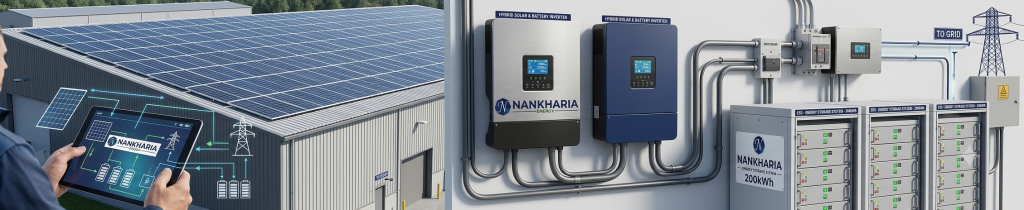
Solar Battery Storage (BESS) for Your Factories in maharashtra — Nankharia Energy
Maharashtra’s new Renewable Energy and Energy Storage Policy has made battery storage mandatory for new commercial and industrial solar at 100 kW and above — effective April 1, 2026. Nankharia Energy helps factories across Maharashtra design, size, and commission compliant, financially sound solar-plus-BESS systems. Array design complies with IEC 62548 standards.
(Cross-link: Running a smaller system under 100 kW? See our Solar Battery Storage for Homes & Small Businesses page instead — the mandate doesn’t apply to you, but storage can still be worth it.)
1. What Is the Solar Battery Storage Maharashtra Mandate and Is Your Factory Affected?
Under Maharashtra’s Renewable Energy and Energy Storage Policy 2025-26 to 2035-36, any new rooftop, grid-interactive, open access, or captive solar project at 100 kW and above applying for fresh grid connectivity must now co-locate battery storage. The requirement, effective April 1, 2026, sets storage capacity at a minimum of 50% of the solar array’s size, with at least 2 hours of discharge duration. That threshold is reviewed periodically and will rise to 4 hours for projects commissioned after FY 2030-31.
Your factory is affected if you are planning a new solar installation at 100 kW or above, or expanding an existing system in a way that requires a fresh connectivity application. If your solar plant already has approved grid connectivity, you are not required to retrofit storage — but the policy actively incentivizes it, including priority connectivity for storage-integrated projects.
In practical terms: a 200 kW rooftop array now needs a minimum 100 kW / 200 kWh battery system alongside it. Below 100 kW, the mandate doesn’t apply, though voluntary storage is encouraged and still pays for itself given current banking and time-of-day tariff changes.
Not sure whether your planned capacity crosses the threshold, or whether an expansion counts as a “new” connection under MSEDCL rules? Talk to our team — we’ll walk through your specific case.
2. The Financial Case for Solar Battery Storage in Maharashtra Nobody Has Shown You Yet
Most solar vendors sell BESS purely as a compliance box to tick. The bigger story is what’s happened to net metering and banking arrangements for C&I consumers.
Maharashtra’s revised MYT order for the current control period has tightened same-slot banking for commercial and industrial solar. In practice, this means the old model — export surplus daytime solar to the grid and draw it back for free in the evening — no longer works the way it used to. Utilities now settle exported units at a low year-end rate, while evening grid power (especially during peak hours) is billed at a materially higher industrial tariff, with a peak-hour surcharge layered on top for HT consumers.
A battery closes that gap. Instead of exporting your midday surplus, you store it and discharge it into your own load during the expensive evening peak window. Industry analysis for 2026 puts the effective saving from this shift at roughly 30-50% of your applicable peak grid tariff, once you account for wheeling charges, cross-subsidy surcharge, and transmission charges you avoid by self-consuming stored power instead of drawing from the grid.
Add to this a 10-year electricity duty holiday available for captive renewable-plus-storage installations under the current policy, and the numbers change meaningfully. For a well-designed solar-plus-BESS project sized correctly for your load profile, payback in Maharashtra’s C&I segment is typically landing in the 4-6 year range in 2026 — not the unrealistic 3-4 year figures some vendor quotes still lead with once financing costs and realistic O&M are excluded.
A note of honesty: any proposal you receive should account for battery degradation (typically 2-3% capacity loss per year), commissioning timelines, and full-life O&M. Ask your EPC to show you the model, not just the headline payback number.
3. Maharashtra’s Storage Numbers in Context: Why This Policy Is Structural, Not Cyclical
It’s worth understanding why this isn’t a temporary regulatory hurdle that will loosen next year.
Maharashtra has set a target of 65% of electricity demand from renewable energy by FY 2035-36, alongside a goal of 100 GWh of cumulative storage capacity across the policy horizon. To get there, DISCOMs — MSEDCL, BEST, Tata Power-Distribution, and Adani Electricity — are themselves obligated to procure storage capacity equal to at least 10% of their demand by FY 2035-36, with at least 85% of that stored energy sourced from renewables annually.
That’s a state-level structural commitment, not a single order that can be quietly rolled back. Maharashtra is the first Indian state to mandate BESS integration for C&I rooftop solar at this scale, but the underlying grid logic — high solar penetration creating a midday surplus and an evening shortfall — applies everywhere solar adoption is accelerating. Other states running large-scale BESS tenders are moving in the same direction, and a national technical standards framework for BESS is expected to follow.
For a heavy industrial state like Maharashtra, with major manufacturing clusters including Pune, Nashik, and Chhatrapati Sambhajinagar drawing significant grid load, storage isn’t a policy add-on — it’s becoming core grid infrastructure. Factories planning solar capacity now are better served designing for storage from day one rather than treating it as a future retrofit.
4. Which Solar Battery Storage System Does Your Maharashtra Factory Actually Need?
Sizing a BESS correctly depends on more than the mandate’s minimum. The right system for your factory depends on:
- Your solar array size — the mandate sets a 50% capacity / 2-hour duration floor, but your actual optimal size may be higher depending on your evening load and how much of your consumption you want to shift off peak-hour tariffs.
- Your load profile — a factory running two or three shifts with high evening demand gets a very different ROI from storage than one that shuts down after the day shift.
- Your connection category — HT industrial, LT commercial, open access, and captive consumers each sit under different tariff structures, and the arbitrage value of stored power changes accordingly.
- Battery chemistry — most C&I installations in Maharashtra are standardizing on lithium-ion (LFP) for cycle life and safety, though the right choice depends on your duty cycle and budget.
- Coupling method — whether storage is DC-coupled with your existing solar array or AC-coupled as a separate system depends on whether you’re building fresh or retrofitting.
Nankharia Energy sizes every BESS proposal against your actual consumption data and tariff category, with array design complying with IEC 62548 standards — not a generic percentage applied to your rooftop capacity. Share your latest 12 months of electricity bills and your solar plan, and we’ll model the right system size for you.
5. Before vs After: Solar Battery Storage Maharashtra at a Mid-Size Factory
Here’s how the shift plays out for a typical mid-size Marathwada factory running a 200 kW rooftop solar system with two-shift operations.
Before BESS (solar-only):
- Solar generates its peak output during midday hours, often exceeding the factory’s daytime load.
- Surplus is exported to the grid under net metering and settled at a low year-end banking rate.
- In the evening, when demand peaks again, the factory draws full power from the grid at the standard industrial tariff — plus a peak-hour surcharge if consumption falls in the 17:00-24:00 window.
- Net result: the factory captures only part of its solar system’s real financial value.
After BESS (solar + storage, sized per the mandate at 100 kW / 200 kWh minimum):
- Midday surplus is stored instead of exported.
- Stored solar is discharged into the factory’s own load during the evening peak window, directly offsetting expensive grid draw.
- The factory avoids wheeling charges, cross-subsidy surcharge, and the peak-hour surcharge on every unit it now self-consumes instead of purchasing.
- The system meets the regulatory storage requirement automatically, since it was sized to the mandate from the outset.
- Combined with the electricity duty holiday available on captive renewable-plus-storage installations, the overall project economics improve meaningfully over the solar-only baseline.
The exact rupee impact depends on your tariff category and load pattern — this is best modeled against your actual bills rather than a generic example. We’re happy to run these numbers for your facility.
6. What Maharashtra Factory Owners Should Do Now to Stay Compliant
The mandate is already in effect — it took effect April 1, 2026, and applies to every new solar project at 100 kW and above filing for grid connectivity from that date onward. If you’re planning a new installation or an expansion that will require a fresh connectivity application, here’s what to do without delay:
- Confirm whether your project falls under the mandate. New systems at 100 kW and above, including open access and captive projects, are covered. Existing systems with approved connectivity are not required to retrofit — but voluntary storage is worth evaluating given the banking and tariff changes.
- Size storage correctly from the design stage, not as an afterthought bolted onto an existing solar quote. A system designed around your actual load profile will outperform one sized only to meet the regulatory minimum.
- Get your DPR and connectivity application aligned with the storage requirement early — MSEDCL and other DISCOMs are now processing new applications against the mandate, and a mismatched application can delay connectivity approval.
- Model the real financial case, including the electricity duty holiday and peak-tariff savings, so you’re making the investment decision on accurate numbers rather than a vendor’s best-case quote.
- Choose a design partner who can certify the array to IEC 62548 standards and size the storage system against your actual consumption data.
For projects at 100 kW and above, Nankharia Energy works across Maharashtra, with capability extending PAN India as we scale — so wherever your facility is located, the sooner your design work starts, the more design flexibility you have to optimize both compliance and returns.
7. How Does Nankharia Energy Design and Commission Your Solar Battery Storage System?
Nankharia Energy handles solar-plus-BESS projects end to end for Marathwada factories, backed by the 40+ year legacy of the Nankharia Group:
- Load and tariff analysis — we start from your actual electricity bills and shift pattern, not a generic sizing formula.
- Compliant array and storage design — array design complies with IEC 62548 standards, and storage is sized to meet or exceed the Maharashtra REES mandate for your project’s capacity.
- DISCOM liaison and connectivity approval — we manage the connectivity application process so your storage requirement is aligned with MSEDCL’s current rules from the outset.
- Component selection — ALMM-compliant panel brands and appropriately rated battery systems chosen for your duty cycle and budget.
- Installation and commissioning — full EPC execution, followed by ongoing AMC support once your system is live.
- Financial modeling — a realistic payback projection that accounts for degradation, O&M, and the duty holiday you’re entitled to, so your investment decision is based on numbers that hold up.
Get in touch with Nankharia Energy to have your factory’s solar-plus-BESS requirement assessed and sized correctly the first time.
9. How Does BESS Work at Night — Is It Backup Power or Peak-Hour Savings? And How Does This Change Under Net Metering, Gross Metering, or Captive Mode?
Arbitrage first, backup second. A grid-tied C&I BESS is primarily built for peak-hour tariff arbitrage, not power backup:
- During the day, solar output beyond your factory’s real-time load charges the battery instead of exporting to the grid.
- In the evening ToD peak window (typically falling between 17:00–24:00, depending on your DISCOM’s tariff schedule), the battery discharges into your own load — avoiding the peak-hour tariff, peak-hour surcharge, wheeling charges, and cross-subsidy surcharge you’d otherwise pay on grid-drawn units.
- Once the battery depletes (systems are typically sized for 2–4 hours under the current mandate), the factory reverts to normal grid draw at standard rates for the rest of the night.
Backup during a power outage is a separate capability, not an automatic one. A standard grid-tied BESS trips offline during a grid outage due to anti-islanding protection, as required by regulation. It will not power your load during a blackout unless the inverter is specifically configured as grid-forming with islanding capability and an automatic transfer switch — that’s a distinct design requirement and cost to plan for upfront if backup matters to you.
How the metering mode changes the economics:
- Net metering / net-billing (10–100 kW): A Grid Support Charge (GSC) applies to consumers with a sanctioned load of 10 kW and above, irrespective of category — it does not apply below that threshold. In the 10–100 kW net-billing bracket, banked energy can only be used within the same ToD slot it was generated in — surplus beyond that is bought back by the DISCOM at the average day-ahead market price, well below retail tariff. Self-consuming via BESS instead of exporting is the clearly better option here.
- Captive / Green Open Access (100 kW and above): Instead of GSC, a banking charge per kWh applies, designed to reflect either actual storage cost or the ToD tariff differential — but banking can span across ToD slots, effectively giving the grid a “virtual battery” role. Whether a physical BESS beats grid banking depends on whether your battery’s amortized cost per kWh undercuts that banking charge. The stronger financial pull toward Captive, though, is the 10-year electricity duty exemption available when at least 4 hours of storage covering 50% of contracted RE capacity is integrated.
- Gross metering: Solar generation is metered and sold to the DISCOM separately at a fixed feed-in tariff, while your factory’s consumption is billed separately at full retail rate — there’s no self-consumption credit. Pairing BESS with gross metering doesn’t unlock tariff arbitrage, since generation and consumption are decoupled transactions; BESS in this setup only makes sense for backup or resilience, not savings.
The right mode for your factory depends on your capacity bracket, load profile, and whether backup reliability matters as much as cost savings. Talk to our team and we’ll map out which combination works best for your specific case.
Source & Regulatory Reference
This page references the Maharashtra Renewable Energy & Energy Storage Policy 2025-26 to 2035-36, approved vide Government Resolution dated 18 March 2026 (Unique Code: 202603181848365810), issued by the Industries, Energy, Labour, and Mining Department, Government of Maharashtra.
Read the official policy document (PDF)
8. How Can You Calculate Your Factory’s Solar Battery Storage Savings?
Every factory’s numbers are different — your load profile, connection category, and existing (or planned) solar capacity all change the answer. Use our Solar Battery Storage Calculator to get a first-pass estimate specific to your facility, sitting right alongside our Solar Generation Calculator.
Enter your solar capacity (or planned capacity), average monthly units consumed, connection category (LT/HT), and shift pattern to see:
- The minimum battery size your project needs under the Maharashtra REES mandate (50% of solar capacity, 2-hour minimum duration)
- Estimated units shifted from evening peak-tariff grid draw to stored solar
- An indicative annual saving range and payback window based on your inputs
Try the Solar Battery Storage Calculator →
This calculator gives a directional estimate for planning purposes. For a proposal built on your actual 12-month billing data, share your bills with our team and we’ll model exact numbers.