
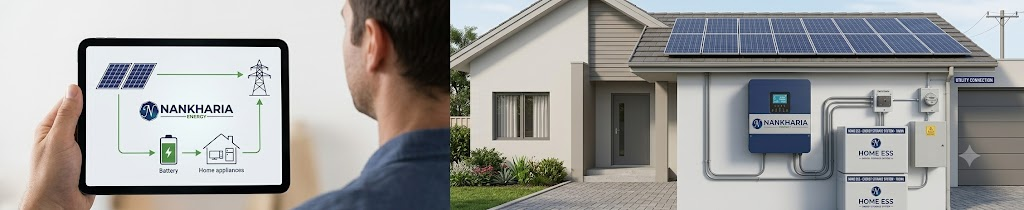
Solar Battery Storage for Homes & Small Businesses — Nankharia Energy
Thinking about adding battery storage to your home or small business solar system? Unlike large factories at 100 kW and above, storage isn’t mandatory for you under Maharashtra’s REES policy — but it can still make a real difference to your savings and power reliability. Here’s what homeowners and small business owners across Marathwada need to know before deciding.
(Cross-link: For factories and large C&I consumers at 100 kW and above, see our Solar Battery Storage for Factories in Maharashtra page, which covers the storage mandate in detail.)
1. Is Battery Storage Mandatory for My Home or Small Shop’s Solar System?
For Homes & Small Rooftop Systems (1 kW – 25 kW)
No. Maharashtra’s REES mandate for battery storage only applies to new grid-connected solar projects at 100 kW and above. If your system is in the 1–25 kW range, adding storage is entirely your choice, not a regulatory requirement.
2. What Size Battery Makes Sense for a Typical 3–5 kW Rooftop System?
Sizing here comes down to your evening consumption pattern, not a formula. For most households running lights, fans, a refrigerator, and a few other appliances after sunset, a 3–10 kWh battery is a reasonable starting range. Share your typical evening usage and we can help size it precisely.
3. Does a Home Battery Provide Backup During Power Cuts?
Only if the inverter is specifically configured for backup — with grid-forming capability and an automatic transfer switch. A standard grid-tied solar system without this configuration shuts down during a grid outage regardless of whether it has a battery, due to anti-islanding safety requirements. If backup during outages matters to you, say so upfront — it changes the design.
4. Is the Grid Support Charge (GSC) Relevant for Small Rooftop Systems, and Does Storage Help?
The GSC applies to consumers with a sanctioned load of 10 kW and above, irrespective of category — it is not applicable below that threshold. So if your system is under 10 kW, GSC doesn’t apply to you at all. For systems at or above 10 kW, self-consuming your stored solar instead of exporting and re-importing from the grid reduces how much you rely on grid banking, which softens — though doesn’t eliminate — the GSC’s impact on your bill.
5. Is a Battery Worth the Extra Cost for a Small Residential System?
It’s a genuine cost-benefit question, not an automatic yes. Payback for residential storage tends to be longer than for C&I systems, since domestic tariffs and load patterns are different. We’d rather run the actual numbers for your household than give a blanket recommendation — reach out with your monthly bill and usage pattern.
6. Hybrid System with Battery vs Normal Net Metering + Separate Off-Grid Inverter + Battery — Which Should You Choose?
There are two ways to add battery storage to a small solar system:
Option 1: Hybrid Inverter System (battery included from day one, or added later)
A single hybrid inverter manages solar generation, battery charge/discharge, and grid interaction together.
Pros:
- Simpler setup — one inverter handles everything, less equipment and wiring
- Seamless switching between grid, solar, and battery
- Battery can usually be added later to a hybrid-ready inverter without replacing it, if planned for upfront
- Better for automatic backup during outages, since the transfer logic is built in
Cons:
- Higher upfront inverter cost than a basic grid-tie inverter
- More complex to service, since one unit handles multiple functions
Option 2: Normal Net Metering Solar System + Separate Off-Grid Inverter + Battery
The solar system stays a standard grid-tied net-metering setup; a separate off-grid inverter and battery bank handle backup independently.
Pros:
- Clean separation between your certified net-metering solar system and your backup setup
- Off-grid inverter can be added, removed, or serviced independently without touching the net-metering system
- Backup capability without modifying your existing solar installation
Cons:
- Two separate systems to install, wire, and maintain
- No automatic seamless transfer between grid/solar/battery — usually needs a manual or semi-automatic transfer switch
- Slightly higher combined cost in some cases due to duplicated inverter capacity
Bottom line: Option 1 suits homeowners who want simplicity and automatic backup in one unit. Option 2 suits those who already have solar installed and want to add backup without touching the existing net-metering system. Talk to our team about which fits your setup.
7. How Long Will a Small Home Battery Actually Last (Runtime), and What’s Battery Life?
Runtime on backup depends on your load size relative to battery capacity — a well-sized battery for essential loads (lights, fans, fridge, Wi-Fi) typically lasts several hours per charge. In terms of overall lifespan, most residential lithium batteries are rated for 4,000–6,000 charge cycles, translating to roughly 10–15 years before capacity fades to around 80% of original.
8. Are There Government Subsidies for Residential Solar Battery Storage in Maharashtra?
Current subsidy schemes, such as PM Surya Ghar, target rooftop solar installation more directly than battery storage. Storage-specific subsidies for small residential systems are limited as things stand — it’s worth checking current scheme details with us before assuming eligibility, since these programs do get updated.
For Small Commercial Consumers (25 kW – Below 100 kW)
9. My Load Is Below 100 kW — Why Consider Storage If It’s Not Mandatory?
Even without the mandate, net-billing consumers in this bracket face same-ToD-slot banking restrictions and Grid Support Charges, so storage can still meaningfully improve your self-consumption economics. It’s a business case, not a compliance one — but for shops, clinics, and small workshops with a meaningful evening load, it’s worth evaluating.
10. If I’m Planning to Expand Toward 100 kW, Should I Design for Storage Now?
Yes. If your business is growing and you expect to cross the 100 kW threshold in the next few years, designing storage-ready from the start — allowing space, wiring, and inverter headroom for a battery — avoids a more expensive retrofit later once the mandate applies to your expanded capacity.
Want to see indicative numbers for your own system? Try our Solar Battery Storage Calculator → — enter your capacity, consumption, and metering mode to get a directional battery size and savings estimate.
Not sure where your system falls, or want a recommendation specific to your home or business? Get in touch with Nankharia Energy and we’ll walk you through the right setup.