
BESS
Nankharia Energy — Battery Energy Storage Systems (BESS) in Maharashtra
Maharashtra now requires new solar projects above a certain size to include battery storage — and even where it isn’t required, storage is changing the economics of solar for everyone. Whether you’re running a factory, a shop, or a home rooftop system, here’s where to find what applies to you.
Maharashtra now requires new solar projects above a certain size to include battery storage — and even where it isn’t required, storage is changing the economics of solar for everyone. Whether you’re running a factory, a shop, or a home rooftop system, here’s where to find what applies to you.
Array design complies with IEC 62548 standards. Backed by the 40+ year legacy of the Nankharia Group.
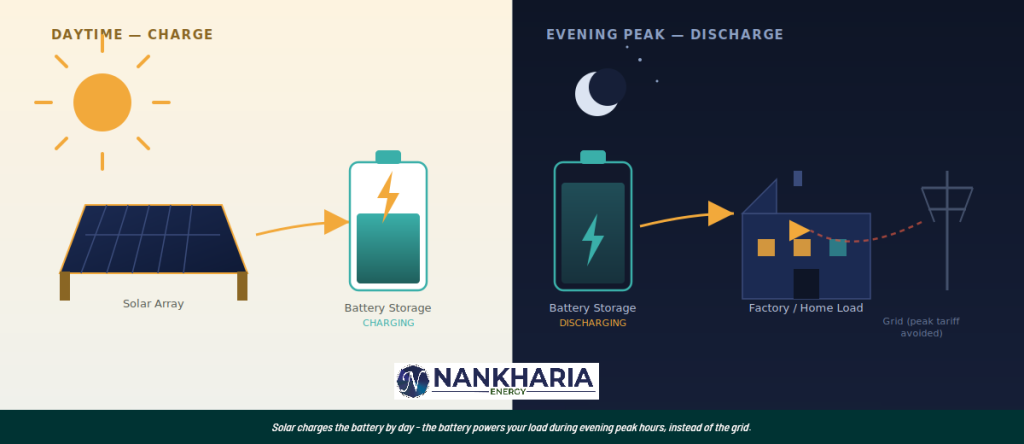
What Is BESS, in Plain Terms?
A Battery Energy Storage System stores surplus solar power generated during the day so it can be used later — typically in the evening, when grid electricity costs more and your own solar panels aren’t producing. Instead of exporting extra solar to the grid at a low rate and buying it back at a high one after dark, a battery lets you capture that value yourself.
Under Maharashtra’s Renewable Energy and Energy Storage (REES) Policy 2025-26 to 2035-36, storage has moved from “optional add-on” to a mandated part of solar design for larger installations — with real financial upside for smaller ones too.
Which Page Is Right for You?
🏭 Running a factory or large facility (100 kW and above)? Battery storage is mandatory for you under the REES policy. Learn what the mandate requires, the financial case, sizing guidance, and what to do next. Solar Battery Storage for Factories & Industry →
🏠 Running a home or small business (under 100 kW)? Storage isn’t mandatory for you, but it can still meaningfully cut your electricity costs — and if you’re growing toward 100 kW, it’s worth planning for now. Covers sizing, backup power, hybrid vs off-grid setups, and subsidies. Solar Battery Storage for Homes & Small Business →
🔢 Want to run your own numbers? Enter your solar capacity — any size — along with your consumption and metering mode to get an instant, indicative battery size and savings estimate. Try the Solar Battery Storage Calculator →
Why This Is Happening Now
Maharashtra has set a target of 65% of electricity demand from renewables by FY 2035-36, backed by a goal of 100 GWh of cumulative storage capacity across the state. DISCOMs — MSEDCL, BEST, Tata Power-Distribution, and Adani Electricity — are themselves required to procure storage equal to at least 10% of demand by FY 2035-36. This isn’t a temporary rule; it’s how the grid is being redesigned to handle high solar penetration without destabilizing supply in the evening.
The policy was approved via Government Resolution dated 18 March 2026 (Unique Code: 202603181848365810), issued by the Industries, Energy, Labour, and Mining Department, Government of Maharashtra.
📄 Read the official policy document (PDF)
How Nankharia Energy Helps
- Load and tariff analysis — sizing based on your actual consumption, not a generic formula
- Compliant design — array design complies with IEC 62548 standards, storage sized to meet or exceed the REES mandate where applicable
- DISCOM liaison — connectivity applications aligned with current storage requirements
- End-to-end EPC — installation, commissioning, and ongoing AMC support
- Honest financial modeling — realistic payback figures accounting for degradation, O&M, and applicable duty exemptions
For projects at 100 kW and above, Nankharia Energy works across Maharashtra, with capability extending PAN India as we scale.
Get in touch to have your solar-plus-storage requirement assessed and sized correctly the first time